
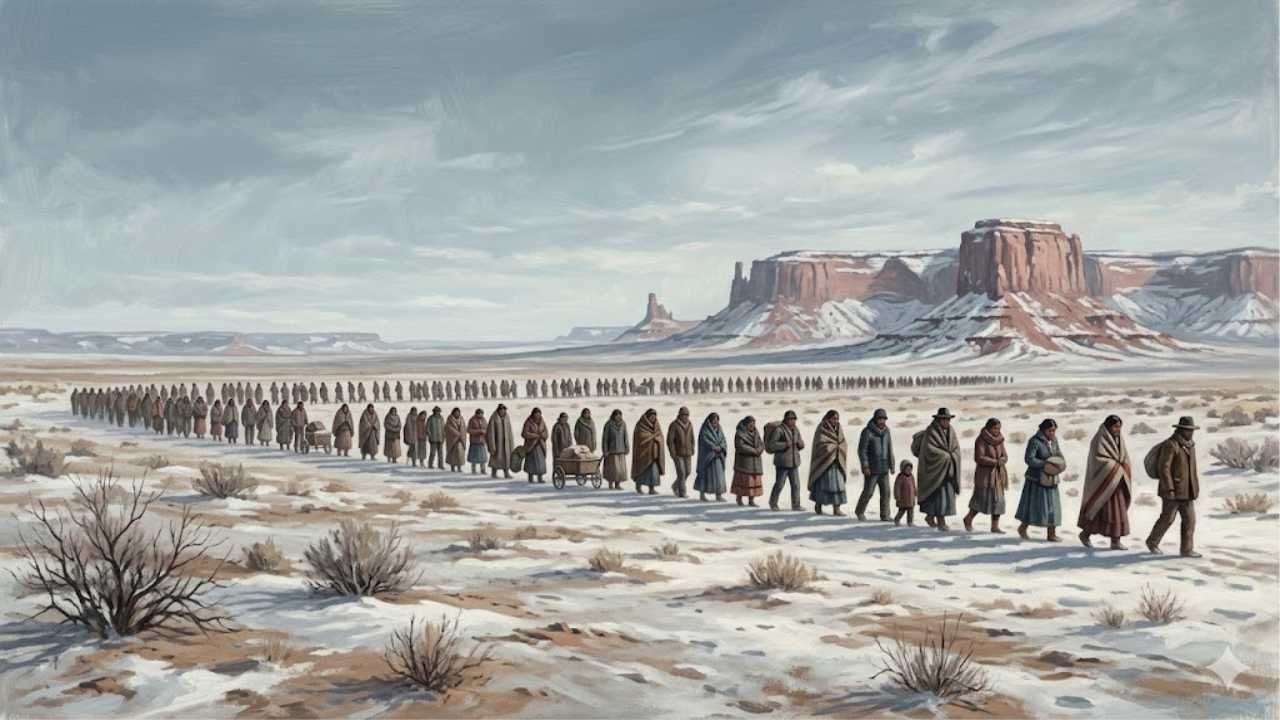
The Long Walk of 1864 — more than 8,500 Diné men, women, children and elders were marched over 300 miles from their homeland to Bosque Redondo on the Pecos River.
The Long Walk: 300 Miles from Home — The Forced Removal of the Diné (1864–1868)
In the winter of 1864, more than 8,500 Diné men, women, children, and elders were forced to march over 300 miles from their sacred homeland to a barren reservation on the Pecos River. What followed was four years of suffering — and one of the most remarkable acts of diplomatic survival in American history.
Of all the events in Navajo Nation history, none carries more weight than the Long Walk. It is the defining trauma of Diné collective memory — the moment when everything the People had built across centuries was stripped away in a single brutal act of government policy. And yet it is also the event from which the extraordinary resilience of the Diné becomes most visible: because they survived it, negotiated their way home, and came back to rebuild a Nation that exists to this day.
To understand the Long Walk fully, you need to understand what came before it — the scorched earth campaign that made mass surrender the only option — and what came after it: the Treaty of 1868 that brought the Diné home. This post covers all of it.
Kit Carson's scorched earth campaign — 1863
By the summer of 1863, General James H. Carleton had decided that the only solution to what U.S. military commanders called "the Navajo problem" was total military subjugation. His orders to Colonel Christopher "Kit" Carson were sweeping: force every Diné person to relocate to a new reservation at Bosque Redondo on the Pecos River in eastern New Mexico. Any who refused to surrender were to be treated as hostile combatants.
Carson understood something important from his years as a frontier scout: the Diné could not be defeated in open battle. They knew their canyon country far too well, could retreat into remote areas that soldiers could not easily penetrate, and had survived military campaigns before by simply moving beyond the reach of their pursuers. As the project source confirms, many bands "realizing that they could not stand and fight against overwhelming odds, retreated farther and farther into the fastnesses of such regions as Navajo Mountain, where they could hide and be safe." Some groups even crossed the San Juan River and escaped northward.
So Carson did not try to defeat the Diné in battle. He chose instead to destroy everything that kept them alive.
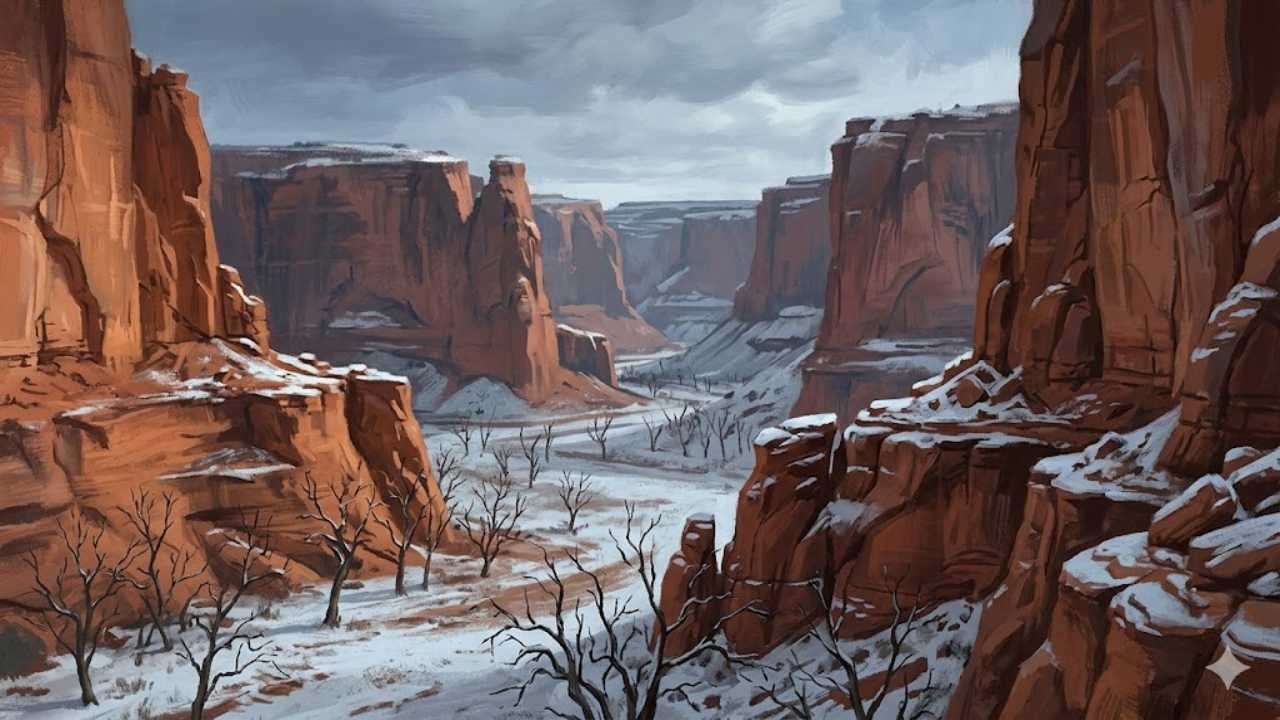
Canyon de Chelly, Arizona — the sacred canyon at the heart of Dinétah where Kit Carson's forces destroyed peach orchards, corn fields, and winter food stores in January 1864, leaving Diné families with no choice but to surrender.
Throughout the second half of 1863 and into January 1864, Carson's forces moved systematically through Dinétah. They burned cornfields. They destroyed winter food stores. They killed livestock. And in the centerpiece of the campaign — the assault on Canyon de Chelly in January 1864 — they cut down the peach orchards that Diné families had cultivated for generations. These orchards were not just food sources. They represented years of labor, community investment, and the kind of settled, rooted life that Diné families had built in the canyon country. Destroying them was a statement: there will be nothing to come back to.
With their food supply gone, winter closing in, and no prospect of relief, thousands of Diné families began making their way to Fort Wingate and Fort Defiance to surrender. The source material records that Carson knew "the only way to conquer the Navajos was to starve them into submission" — and he was correct. By early 1864 the surrenders had become a flood.
"Word went out that those who surrendered peacefully would be treated well. For the sake of their families, small groups began appearing at Fort Wingate. When most of them had arrived, they were sent east to Fort Sumner." — Source: navajo_nation_history.pdf
The march — over 300 miles through winter
The Long Walk was not a single event. It was a series of forced marches conducted in multiple groups between 1864 and 1866, with the largest and most devastating taking place in the spring of 1864. Groups of Diné men, women, children, and elders were marched eastward out of their homeland — across the Rio Grande, through the high desert of central New Mexico, to the Pecos River valley more than 300 miles away.
The conditions were brutal. Many marchers were inadequately clothed for the cold. Food was insufficient. The pace was relentless. Those who could not keep up were left behind — or worse. Elderly people, pregnant women, and young children suffered most severely. Accounts from Diné oral tradition describe people dying of cold and exhaustion along the route, of families being separated, of individuals disappearing and never being heard from again.
It is important to note that approximately half of the Diné population did not make the walk. As the source confirms, roughly half managed to evade capture by retreating into remote mountain country — Navajo Mountain, the San Juan River country, and other areas where soldiers could not effectively pursue them. These hidden survivors maintained a thread of continuity that would matter enormously when the time came to return.
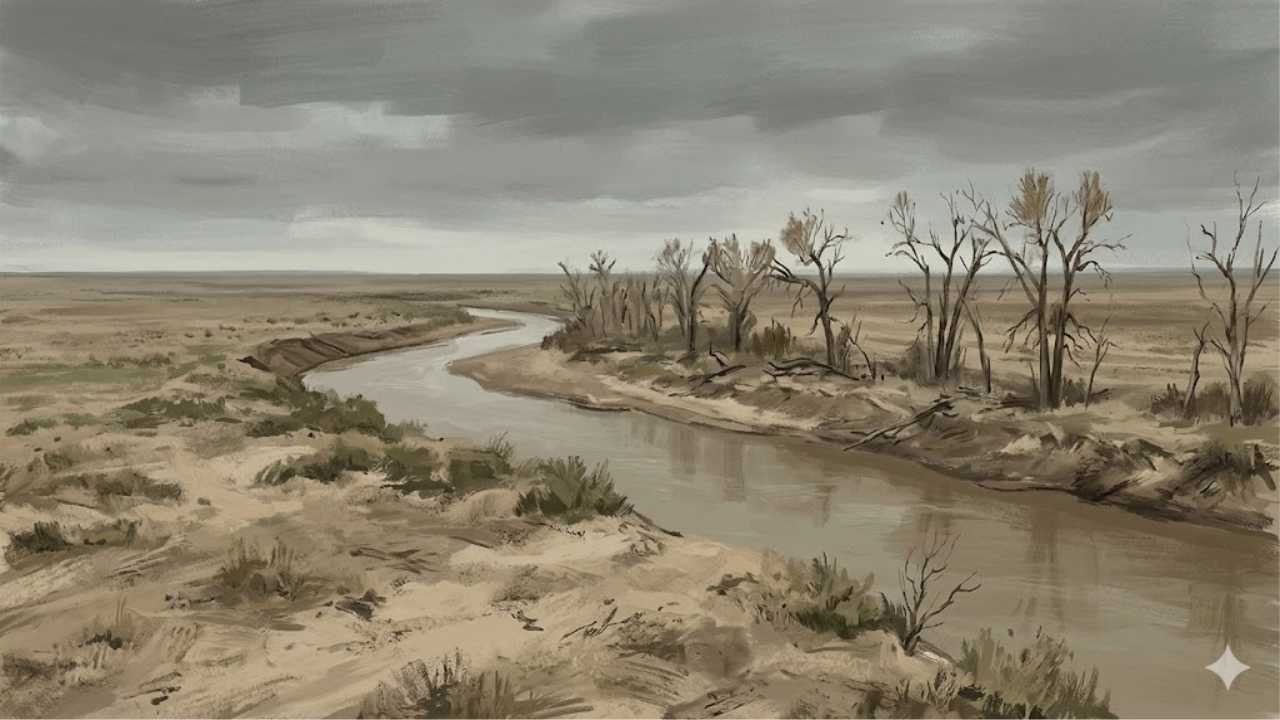
The Pecos River valley at Bosque Redondo, eastern New Mexico — the site where 8,570 Diné captives were held from 1864 to 1868. The land proved unsuitable for farming and the water caused illness.
Four years at Bosque Redondo — Fort Sumner
General Carleton's vision for Bosque Redondo was, in his own terms, a humanitarian one. He planned to settle the Diné in villages where they would become farmers, receive education, and be gradually integrated into American society. The plan was a catastrophic failure on every level.
The land at Bosque Redondo was poorly suited to agriculture. Crops planted in the sandy soil of the Pecos River valley were ravaged by insects and drought before they could be harvested. The source is specific: "the ground was poor, and insect pests ravished the crops as soon as they appeared above the surface." Water drawn from the Pecos River made people ill. The Comanche — not party to any of this — raided the Diné captives regularly, taking what little they had managed to accumulate.
The captive population recorded in 1864 was 8,570 people. Through the four years of captivity, disease, malnutrition, and the harsh conditions of the reservation took a significant toll. The Diné called Fort Sumner Hwéeldi — a word that carried connotations of suffering and hardship — and oral accounts passed down through generations describe those years as a time of profound collective trauma.
The captive population in 1864 was recorded at 8,570. Carleton's plan to settle the Diné as farmers at Bosque Redondo failed because the ground was poor, insects destroyed crops, river water caused illness, and Comanche raiders attacked the captive community. When General William Tecumseh Sherman visited Fort Sumner in 1868, he found the Diné a "beaten people" — who nevertheless pleaded not for freedom in the abstract, but specifically to be allowed to return to their own land.
General Sherman visits — and the Diné make their case
By 1868, it was clear to most U.S. officials who had actually seen Bosque Redondo that the experiment had failed. The cost of maintaining the captive population was enormous, the humanitarian situation was worsening, and the policy was producing nothing like the agricultural self-sufficiency Carleton had promised.
In May 1868, General William Tecumseh Sherman — one of the most powerful military figures in post-Civil War America — traveled to Fort Sumner to assess the situation personally. What he found was a community in desperate condition. As the source records, "the Navajos were a beaten people. They pleaded for peace, asking only that they be allowed to return to their former lands, and promised never to fight again."
What happened in the negotiations that followed was remarkable. The Diné did not simply accept whatever terms Sherman offered. Led by the respected leader Barboncito — whose eloquence and dignity in the negotiations became legendary — the Diné made a clear and specific demand: they wanted to go home. Not to some other reservation. Not to Indian Territory in present-day Oklahoma, which Sherman initially proposed. Home — to Dinétah, to the land between the four sacred mountains.
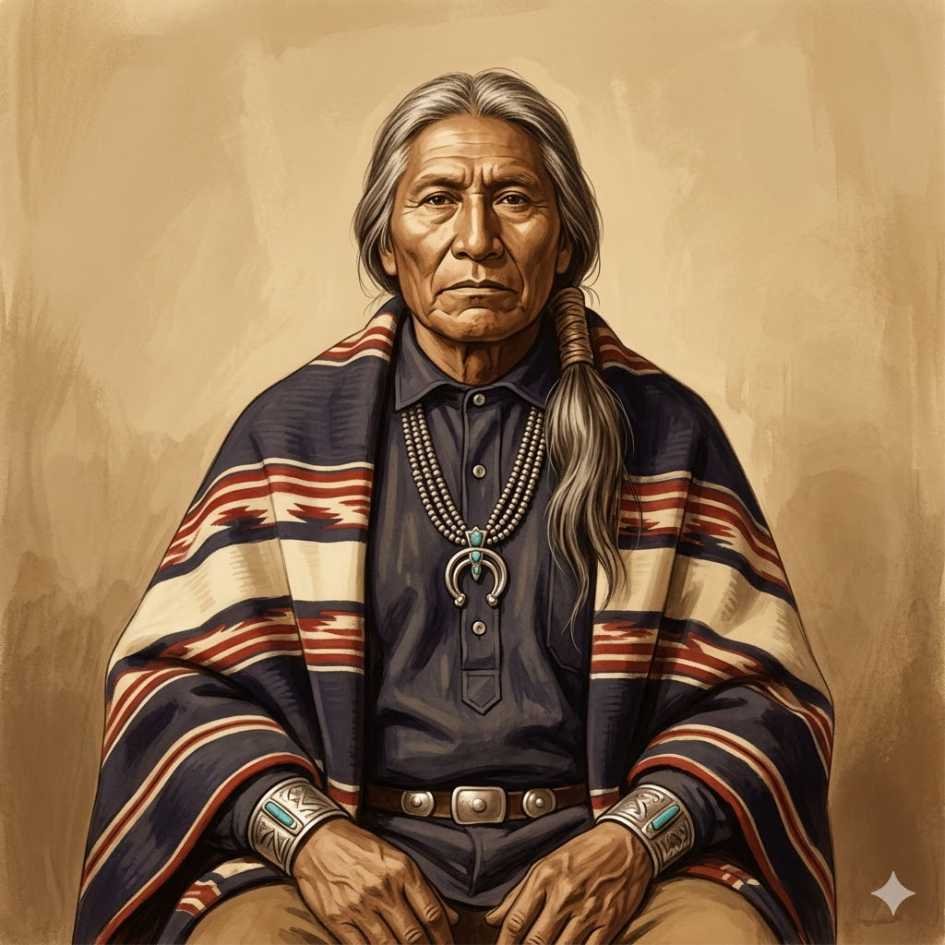
Barboncito — the Diné leader whose eloquence and determination during the 1868 negotiations with General Sherman secured the Treaty that brought the Diné home to their homeland.
Sherman was persuaded. Whether by Barboncito's eloquence, by the practical failure of the Bosque Redondo experiment, or by the straightforward economics of continuing to fund a failing reservation, Sherman agreed to a treaty that allowed the Diné to return to their homeland.
The Treaty of 1868 — coming home
The Treaty of 1868 — formally the Treaty of Peace Between the United States of America and the Navajo Tribe of Indians — was signed on June 1, 1868. It was the last treaty the United States government would sign with the Navajo people, and one of the most consequential documents in the history of the American Southwest.
Under its terms, the Diné were granted a reservation of approximately 3.5 million acres within a portion of their traditional homeland — far smaller than the territory they had roamed, but located in the heart of Dinétah, between the sacred mountains. The U.S. government agreed to provide sheep, goats, seeds, and agricultural tools to help the Diné rebuild. In return, the Diné agreed to send their children to American schools and to cease raiding.
On June 18, 1868 — just days after the treaty was signed — the Diné began the long walk home. This walk was different from the one that had brought them to Fort Sumner four years earlier. This one was chosen. Accounts passed down through Diné oral tradition describe the moment when the marchers first saw the sacred mountains of their homeland on the horizon — and what it meant to the People who had survived four years of captivity to see those peaks again.
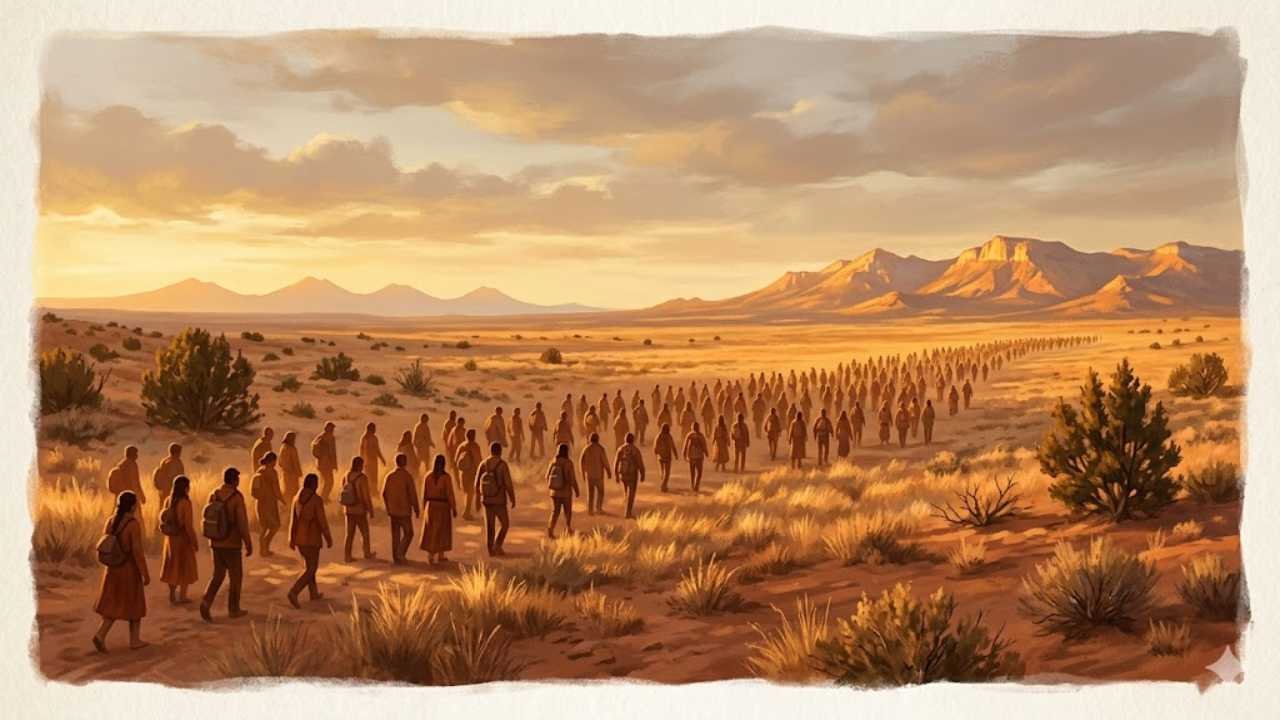
After signing the Treaty of 1868, the Diné began the walk home to Dinétah — the moment Barboncito had negotiated for, and one of the most significant homecomings in American history.
What the Long Walk means today
At home again, the government issued each person three sheep and a goat — a small beginning, but a beginning. The Diné, as the source notes, "began to hold their heads up again." The reservation of 3.5 million acres in 1868 was far too small for the population it needed to sustain, and over the following century — through a series of executive orders and legislative acts — the Navajo Nation would grow the reservation to its current 16 million acres. The captive population of 8,570 in 1864 had grown to an estimated 17,200 just twenty years later.
The Long Walk remains the central event in Diné collective memory. It is taught in Navajo Nation schools, honored in community ceremonies, and referenced in Diné political and cultural life whenever questions of sovereignty, land rights, or identity come to the surface. The generation that survived Fort Sumner and walked home built the foundations of the modern Navajo Nation. Their survival was not passive endurance — it was an act of deliberate, determined resistance.
Barboncito's words at the 1868 negotiations have been quoted in countless contexts since. He did not ask for mercy. He asked for home. And he got it.
- Project file — navajo_nation_history.pdf (Watson, 1973): Kit Carson's scorched earth strategy confirmed; Canyon de Chelly campaign; half population evaded capture; Carleton's failed farming plan; insects destroyed crops; river water caused illness; Comanche raids on captives; General Sherman's visit 1868; Diné "beaten people" who asked to return home; government issued three sheep and a goat per person; captive population 8,570 in 1864; 17,200 estimated twenty years later; reservation grew from 3.5M to 16M acres.
- General historical knowledge: Kit Carson and General James H. Carleton; Bosque Redondo / Hwéeldi; Barboncito's role in 1868 negotiations; Sherman's proposal of Indian Territory (Oklahoma); Treaty of 1868 signed June 1; return march began June 18, 1868; treaty terms including sheep, goats, seeds and school provisions; Navajo oral traditions of the Long Walk and the return.
- McNitt, Frank (1973), Navajo Wars — listed in project file bibliography.
- Note: Diné oral accounts of the Long Walk referenced respectfully. No restricted cultural content elaborated. Canyon de Chelly discussed in historical context only.
Test your knowledge — 5 questions
Click "Reveal answer" under each question to check your response.
Reveal answer
✓ Correct answer: C — 8,570 people
The captive population at Fort Sumner in 1864 was recorded at 8,570 — roughly half the estimated Diné population, as approximately half evaded capture by retreating into remote areas.
Reveal answer
✓ Correct answer: B — Destroying food supplies
Carson knew direct battle would fail as the Diné knew their country too well. Instead he burned crops, destroyed peach orchards and killed livestock — starving communities into surrender.
Reveal answer
✓ Correct answer: B — Poor soil, insects, contaminated water and Comanche raids
The project source confirms all four causes: poor ground, insects destroying crops above the surface, river water causing illness, and Comanche raids taking what little the captives still possessed.
Reveal answer
✓ Correct answer: D — Barboncito
Barboncito's eloquence and determination during the 1868 negotiations with General Sherman secured the Treaty that allowed the Diné to return home to Dinétah rather than relocate to Indian Territory in Oklahoma.
Reveal answer
✓ Correct answer: B — 3.5 million acres; three sheep and a goat; 17,200 by 1884
The 1868 treaty granted 3.5 million acres. The government issued each person three sheep and a goat to begin rebuilding. Twenty years later the Diné population had grown from 8,570 to an estimated 17,200 — a testament to their extraordinary resilience.